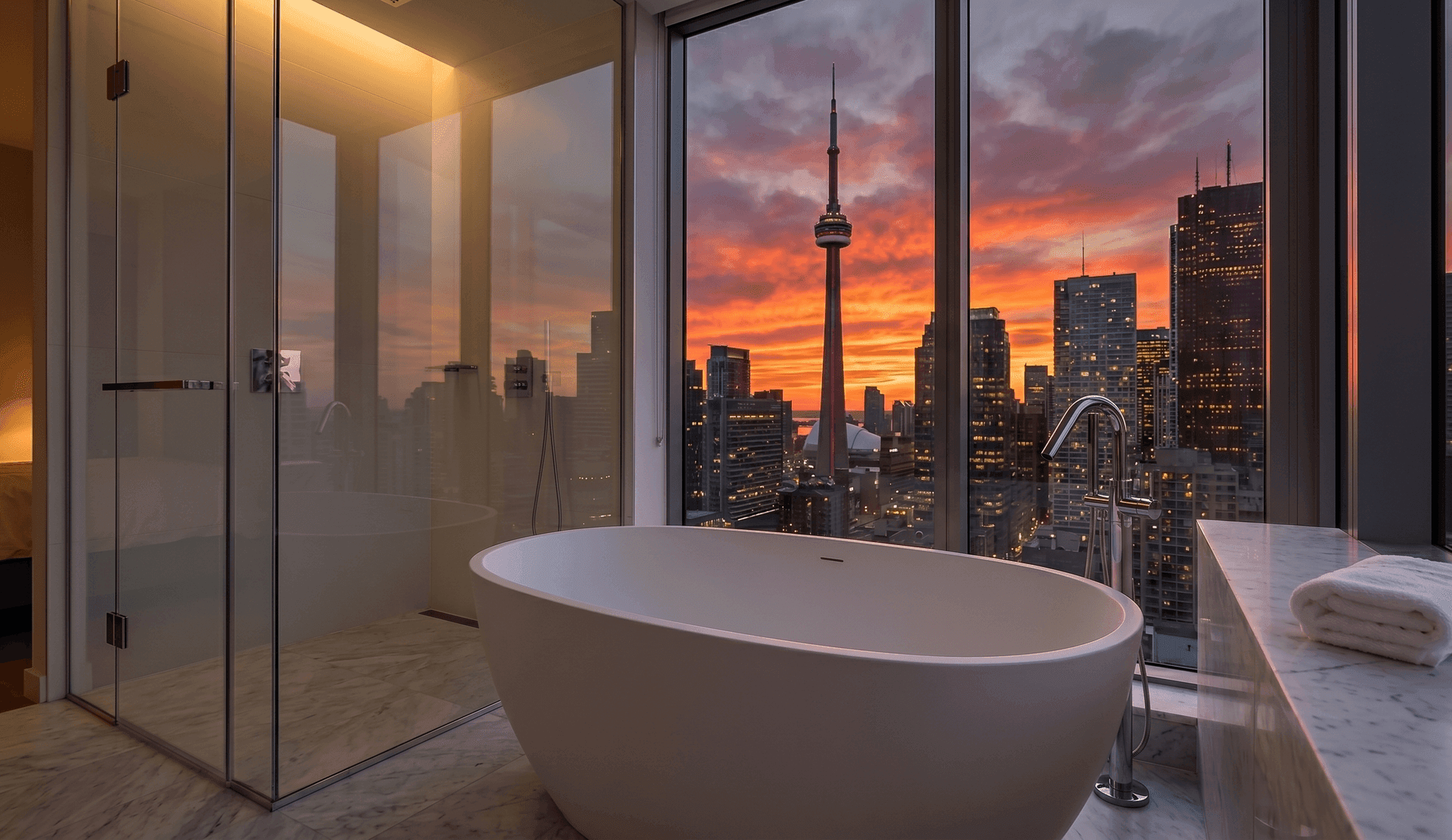
Frameless Glass & Mirror Service Across Toronto & Etobicoke.
This is the City of Toronto service zone — one of four operational zones Built By Glass covers across the GTA. From here we dispatch to four primary cities — Toronto, Etobicoke, North York and Scarborough — plus every neighbourhood inside the City boundary. Same-week measures, founder-led standard, five-year warranty.
Frameless glass for Toronto & Etobicoke, delivered.
Toronto homes are some of the most varied we work in — pre-war Beaches duplexes, downtown condos, Forest Hill renovations, mid-century Don Mills bungalows, and Etobicoke lakeside contemporaries. Every project gets a custom measure and a single-day install.
We work in occupied condos with full COI and elevator booking, in heritage-flagged neighbourhoods with substrate quirks, and in new builds where we coordinate directly with the tile installer to nail timing. Wherever your Toronto home is, we get the glass right.
From across the GTA.
Every street in Toronto & Etobicoke.
From condo bathrooms in the core to lakefront homes in the surrounding municipalities — we install across the entire City of Toronto.
City of Toronto · Core
TorontoDowntown condos, Yorkville, King West, Forest Hill, Rosedale, Leslieville, The Beaches and every neighbourhood inside the 416 core. Frameless glass installation in Toronto →
City of Toronto · West
EtobicokeHumber Bay lakefront condos, The Kingsway Tudor renovations, Mimico, Long Branch and Stonegate-Queensway detached homes. Glass installer in Etobicoke →
City of Toronto · North
North YorkWillowdale and Bayview Village high-rises, Don Mills and Lawrence Park estate renovations, plus Hoggs Hollow custom builds. Glass installation in North York →
City of Toronto · East
ScarboroughBluffs lakefront homes, Agincourt and Wexford mid-century renovations, plus new infill and townhouse developments. Glass installation in Scarborough →
What we install here.
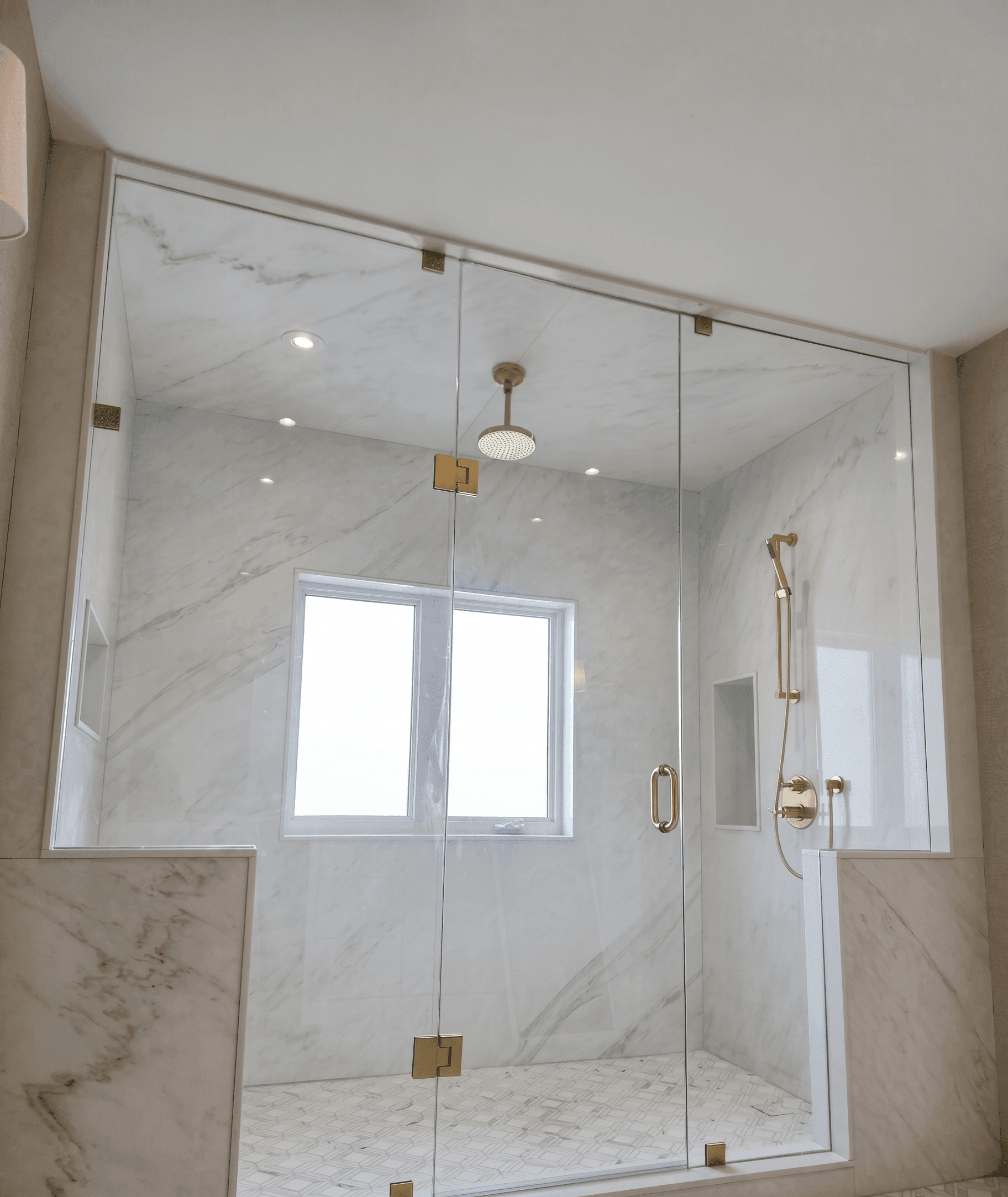
Frameless Showers
Custom enclosures across every neighbourhood in Toronto & Etobicoke. 10mm & 12mm tempered, five hardware finishes.
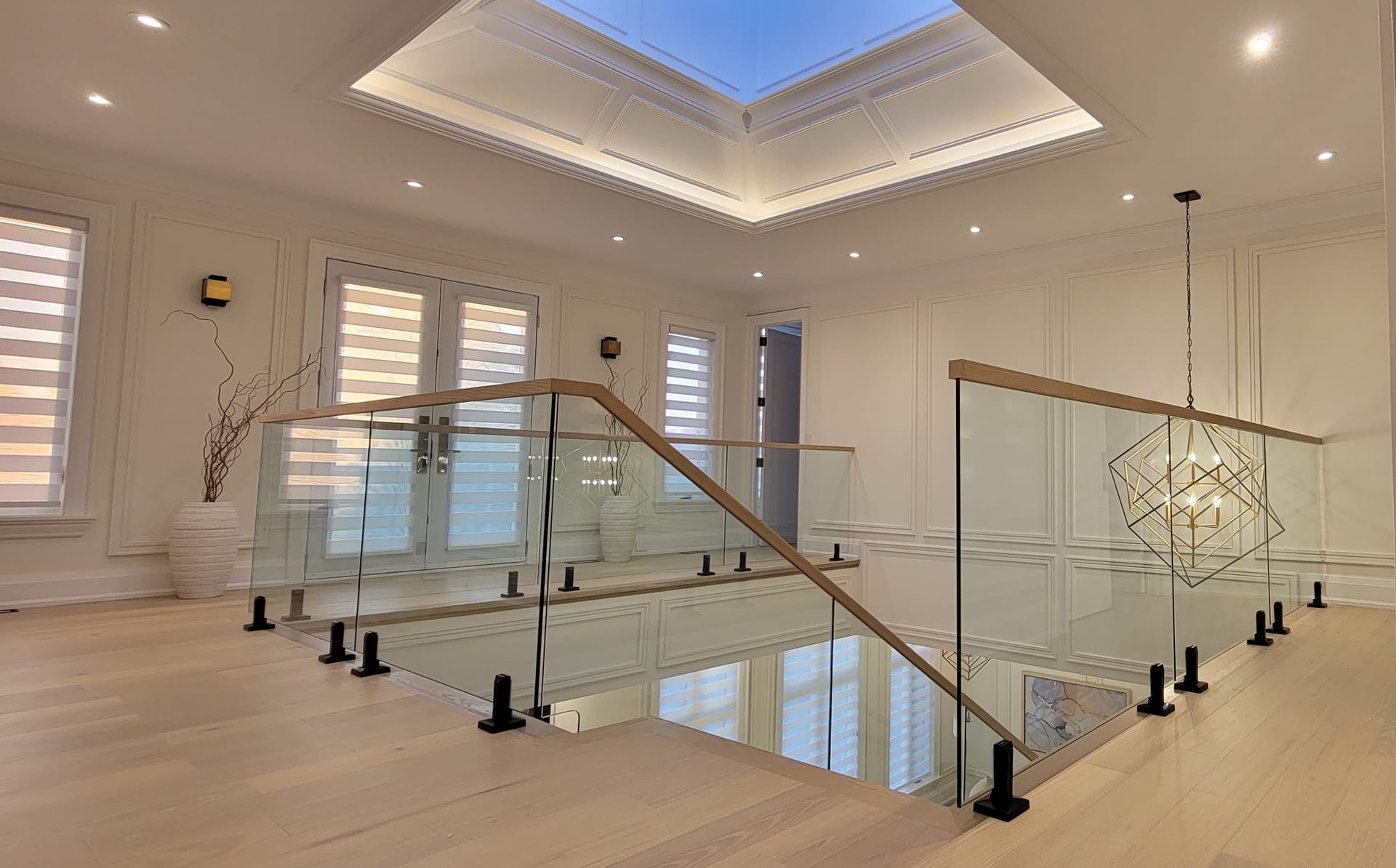
Glass Railings
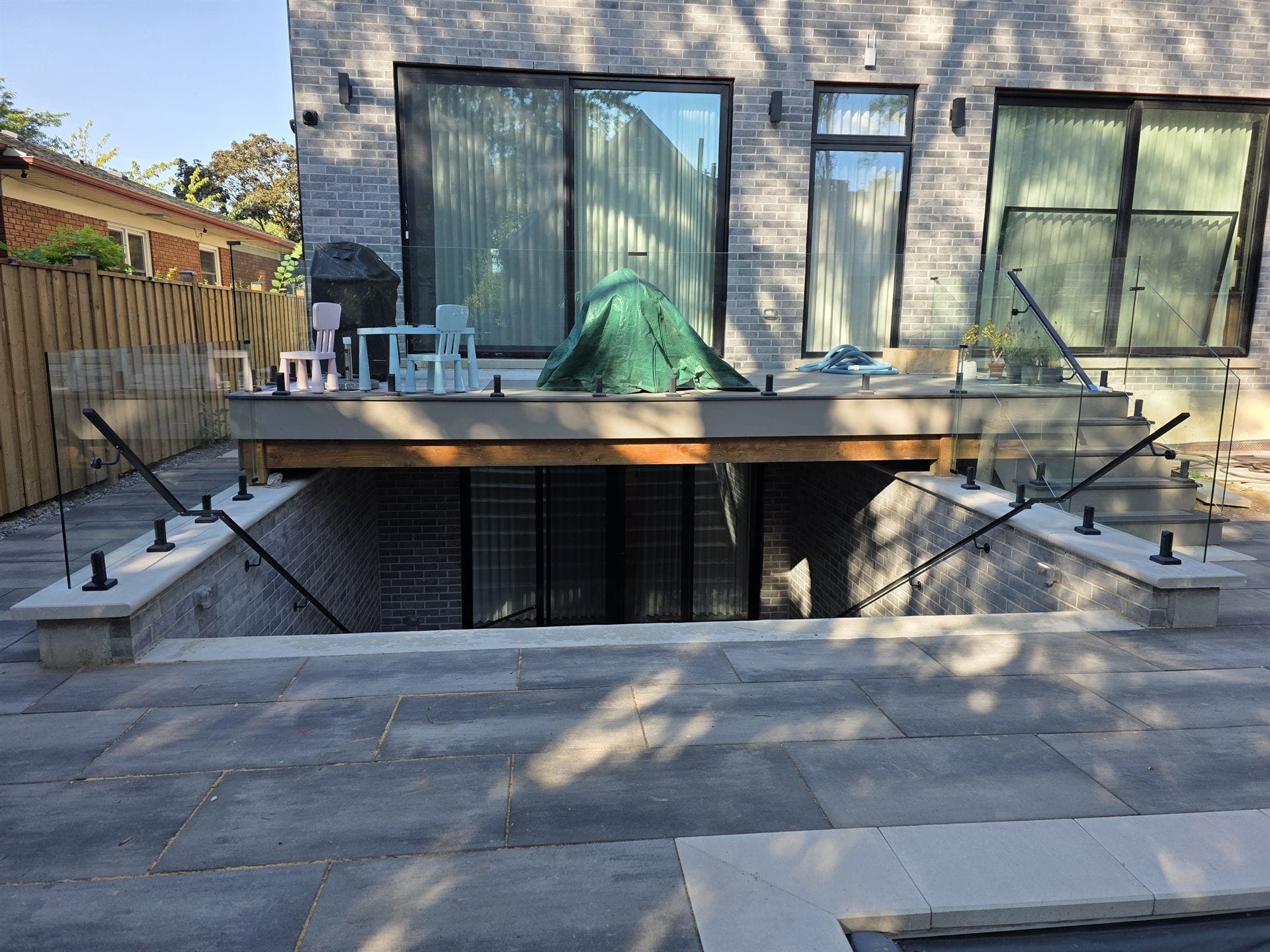
Interior stair railings, mezzanines, and exterior balcony/deck guards. OBC compliant.
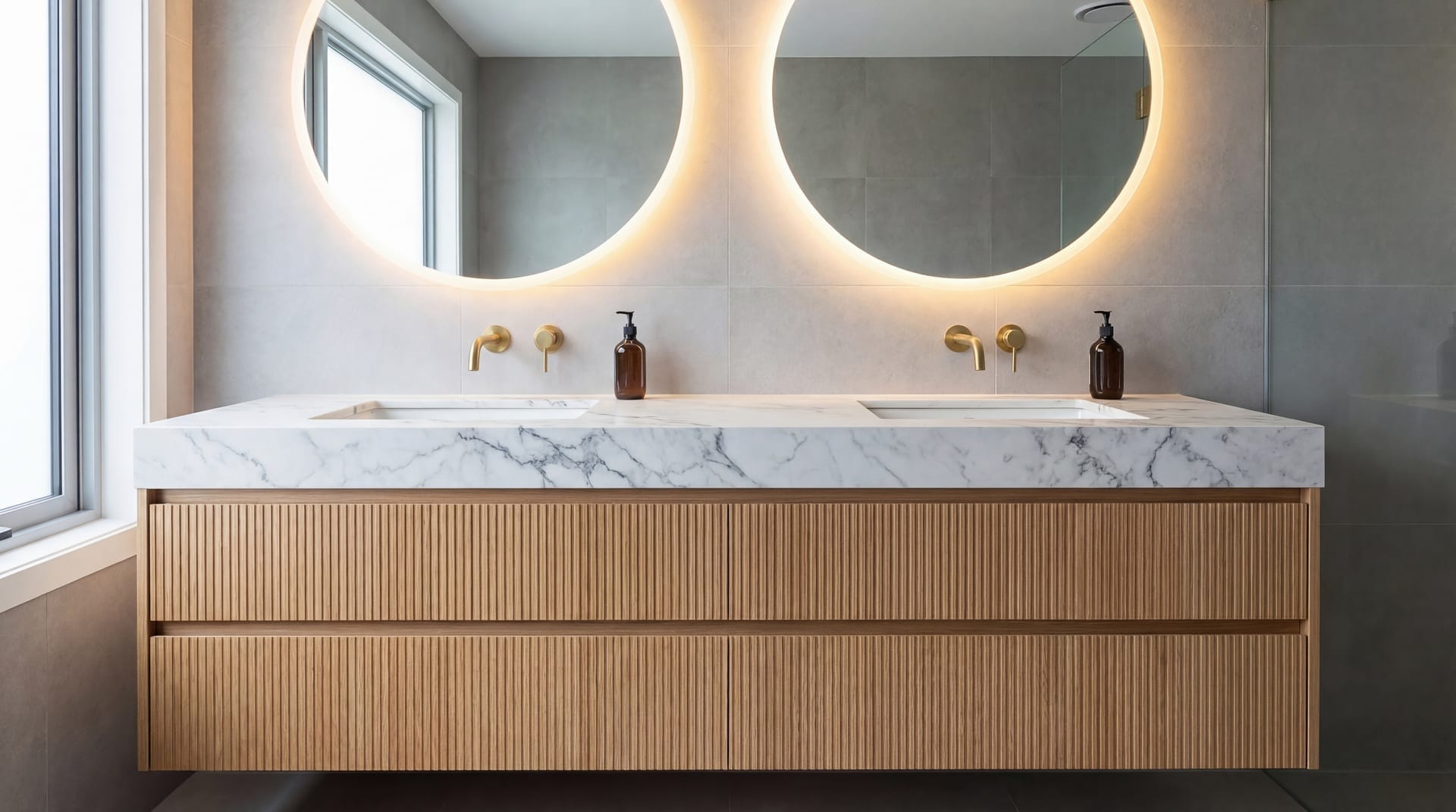
Custom Mirrors
Wall-to-wall, gym walls, LED backlit vanity, antique-finish statement pieces.
Commercial Glazing
Office partitions, storefronts, entry systems, retail and medical fit-outs.
What Toronto & Etobicoke glass projects actually look like.
A senior installer's view of the City of Toronto service zone — permit landscape, housing characteristics, and dispatch logistics from our Pickering headquarters.
Permit landscape across the City of Toronto
The City of Toronto has been a single amalgamated municipality since 1998, which makes it the simplest zone in our coverage area from a permit standpoint. Glass installation work in Toronto, Etobicoke, North York and Scarborough all falls under one building department — Toronto Building — with branch offices in each community council district. Same forms, same code interpretation, same review process across the whole zone.
For interior frameless shower installation in a private residence, no building permit is required: tempered safety glass under ANSI Z97.1 / CAN/CGSB 12.1 is the governing standard, and every panel we install meets it. For exterior glass railings on decks, balconies, or mezzanine guards that exceed 600 mm above grade, Ontario Building Code Section 9.8 applies. We provide engineering documentation and compliance letters on request — typically required when the railing is part of a larger renovation tied to an existing building permit, or when Toronto Plan Review is involved.
Toronto condo installations follow a different protocol. Property management is the gatekeeper, not the City. Every condo install requires a Certificate of Insurance (COI) naming the property management company as additional insured, elevator booking through the building office, and scheduling within the building's noise bylaws — typically 9 am to 5 pm on weekdays for invasive work. We've completed installs in towers across King West, Liberty Village, Yorkville, Mimico, Humber Bay, the financial district, and the Bay Street corridor. The COI and elevator coordination are handled in the week before installation; the visit itself is a single day.
Housing stock & typical project types
The Toronto zone has the most varied housing stock of any zone we cover. A typical month might see us installing a 10 mm pivot enclosure in a downtown King West condo on Monday, an Edwardian renovation with smoked-grey glass in Roncesvalles on Tuesday, and a curbless walk-in on a Don Mills mid-century rebuild on Wednesday. The glass specification, hardware finish, and install approach shifts noticeably between districts.
Downtown Toronto and waterfront Etobicoke high-rises typically receive 10 mm tempered enclosures with matte-black or brushed-nickel hardware. Floor-to-ceiling unit dimensions force a working compromise — most condo bathrooms aren't tall enough for the 96"+ glass panels we install in detached homes, so the design range sits comfortably in the 78"–84" panel height with header brackets where required. Etobicoke's older Tudor and post-war neighbourhoods — The Kingsway, Stonegate-Queensway, parts of Mimico — often request smoked grey or bronze-tinted glass to complement traditional fixtures and darker tile palettes.
North York executive renovations — Bayview Village, Hoggs Hollow, Lawrence Park, parts of Don Mills — lean toward 12 mm clear glass on larger walk-in showers, often paired with curbless drainage and full-height fixed panels. Scarborough's Bluffs lakefront and the newer infill builds in Agincourt and Wexford see a more mixed specification: substantial mirror installations in primary bathrooms, full-height shower walls, and a meaningful share of glass railing work on rebuilt staircases. For railings across the entire Toronto zone the split is roughly even between interior open-tread staircases in mid-century renovations, exterior balcony glass on condo terraces, and rooftop deck glazing in downtown townhouses.
Travel & dispatch from our Pickering HQ
Our installation crew dispatches from Pickering. The Toronto zone sits 30–55 km from our headquarters depending on the address, which translates to 45–75 minutes of drive time depending on commute and route. Downtown installations are typically scheduled with a late-morning window (10 am – 12 pm arrival) to avoid the heaviest 401 westbound morning crawl. Etobicoke's western edge — Long Branch, Mimico, parts of The Kingsway — is the longest single drive from HQ, usually 60–75 minutes via the 401 or Gardiner.
North York and Scarborough are often easier than downtown. The 407 ETR runs along the northern edge of both districts, which lets us bypass the 401 chokepoint and arrive faster during morning rush. Free in-home measures across the Toronto zone are typically scheduled within two business days of first contact; installations follow our standard 10–14 business day fabrication window from approved measurement. For condo installs the install date is fitted to the building's noise restriction window, which most Toronto towers set at 9 am – 5 pm weekdays — comfortably accommodating our typical 4–6 hour install duration.
Toronto-zone design decisions a homeowner usually wrestles with
A few decision points come up consistently in Toronto-zone consultations that don't dominate the conversation in other zones. The first is glass-type selection on small condo bathrooms. With limited natural light, downtown core units often benefit from low-iron starphire glass (which removes the green tint visible at panel edges in standard tempered glass) rather than the standard clear spec — the visual difference is meaningful in a 40 sq ft bathroom in a way it isn't in a 150 sq ft suburban ensuite.
The second is the curb-vs-curbless question on detached-home masters in The Beaches, Roncesvalles, Riverdale, and the Etobicoke detached pockets. Pre-war housing typically wasn't built with curbless drainage in mind; converting to curbless requires the renovation contractor to recess the shower base into the subfloor before tile, which materially affects project scope and budget. We can install a frameless enclosure successfully against either approach, but the conversation has to happen with the tile installer before glass is measured — not after. We flag this at the consultation stage for any pre-war Toronto detached project.
The third is hardware finish coordination on multi-piece installs. Toronto homeowners renovating a master ensuite often add a powder room mirror, a freestanding linen-closet glass door, and (in townhouses) a stair railing on the same project — and each piece has different visible hardware. We standardize the finish family across a single Toronto project rather than mixing matte black hinges on the shower with brushed nickel mirror clips down the hall, even when no individual piece would be visibly wrong on its own. A typical Toronto-zone consultation includes 15–20 minutes on finish coordination before we touch dimensions.
Heritage districts, special conditions, and what to flag at booking
Toronto contains over 20 designated Heritage Conservation Districts (HCDs) spanning Cabbagetown, Yorkville, Riverdale, Wychwood Park, Old Town, parts of The Beaches, and several Etobicoke and North York pockets. For interior glass work the HCD designation has no effect — we operate inside the building envelope without involving the City's heritage planning team. For exterior glass work visible from the street — exterior balcony railings on heritage townhouses, glass entry vestibules, exterior glazed extensions — Toronto's Heritage Planning unit may have review input, even when no permit threshold is triggered. We've worked in HCDs across the Toronto zone and can flag at the measure stage whether your project crosses into a Heritage Planning conversation.
A few other Toronto-zone-specific situations worth raising at first contact: pre-war buildings often have non-square framing that adds measurable variance to the templating step — we use an electronic laser at every measure to capture out-of-plumb conditions accurately. Condo bathrooms with shared plumbing walls sometimes require coordination with the unit below for any drilling work; this is rare for frameless shower hardware (which anchors into tile, not through the slab) but matters for railing anchor points on terrace overlooks. Lakefront condos along the Etobicoke waterfront and the eastern Beaches occasionally face wind-load considerations for exterior glass — for any unit above the 20th floor we move to a higher-load hardware spec as a standard. Mentioning the building, floor, and unit type at first contact lets us quote accurately and avoid surprises at the install stage.
The single most useful thing a Toronto-zone homeowner can do at first contact is share three pieces of information: the property type (detached, semi, townhouse, condo with floor), the approximate construction era (pre-war, post-war, mid-century, modern, new build), and the tile-completion status of the bathroom or stair area receiving glass. With those three data points we can scope the project, flag any of the considerations above proactively, and estimate scheduling realistically rather than relying on generic ranges.
Local, in every sense.
Same-Week Scheduling
Same-week measures and quotes for Toronto & Etobicoke. Our installation crew is dispatched from Pickering — well within range for all City of Toronto addresses.
In-House Installers
Founder-Led Standard. The same crew that measures your Toronto & Etobicoke home does the install — accountability and craftsmanship guaranteed.
Local Track Record
Hundreds of completed installs across the Toronto service zone — across downtown condos, Etobicoke detached homes, North York renos and Scarborough new builds. Founder-led on every site since 2015, with a 5.0-star Google rating from 82 verified GTA homeowners.
Frequently asked, thoroughly answered.
Yes — Toronto & Etobicoke is one of our most active service areas. Our installation crew dispatches from our Pickering headquarters and reaches all of City of Toronto within the same business day for measures and installs. Most Toronto-core jobs are measured within two business days of booking.
Pricing varies by glass type, configuration, and size. Use our Build & Price tool for a project-specific range, or book a free in-home measure for an exact quote. Minimum project charge is $850 for showers and $1,400 for railings.
Same-week scheduling is typical for Toronto & Etobicoke and City of Toronto. After consultation, custom-tempered glass takes 10–14 business days to manufacture and the install itself is a single-day visit. We accommodate evening and Saturday measures for working professionals.
Yes. We work in condo buildings throughout Toronto & Etobicoke regularly. We coordinate with the building's property management for elevator booking, certificate of insurance submission, and after-hours work where required. Most condo installations can be meticulously measured, custom-engineered by our certified fabrication partners, and installed seamlessly without disrupting building common areas.
Every installation we deliver in Toronto & Etobicoke meets or exceeds Ontario Building Code requirements. For railings, we provide engineering documentation and Ontario Building Code Part 9, Section 9.8 compliance letters on request. For showers and mirrors, we use ANSI Z97.1 / CAN/CGSB 12.1 tempered safety glass on every panel.
Built right. Built once.
Tell us about your project. We'll respond within 24 hours with a free consultation and an honest preliminary estimate — no high-pressure sales.